What gangway is
gangway gives any containerized app a public HTTPS URL on your own domain. It runs as a single process on a plain Docker host, with no Kubernetes, and you host it yourself.
You get a URL in three ways, and all three make the same kind of preview:
- A pull request opens or updates. The preview is linked from a sticky comment and torn down when the pull request closes.
- An agent calls the MCP
deploytool. It works with Claude Code, Codex, Cursor, VS Code or any MCP client. The call returns once the URL actually answers. - A person deploys from the web UI or the REST API: drop in a folder, paste a Compose stack, or point at a git ref.
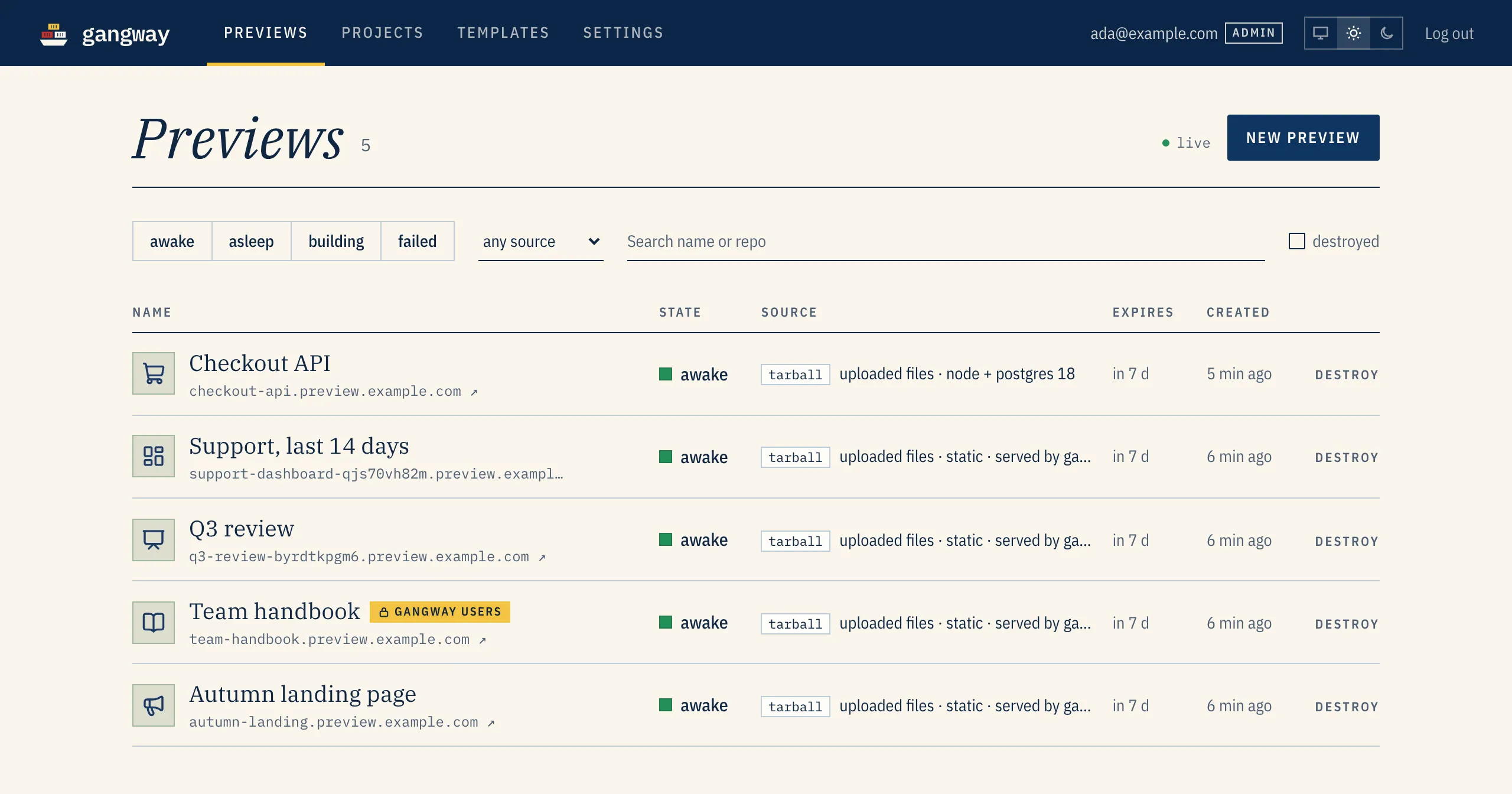
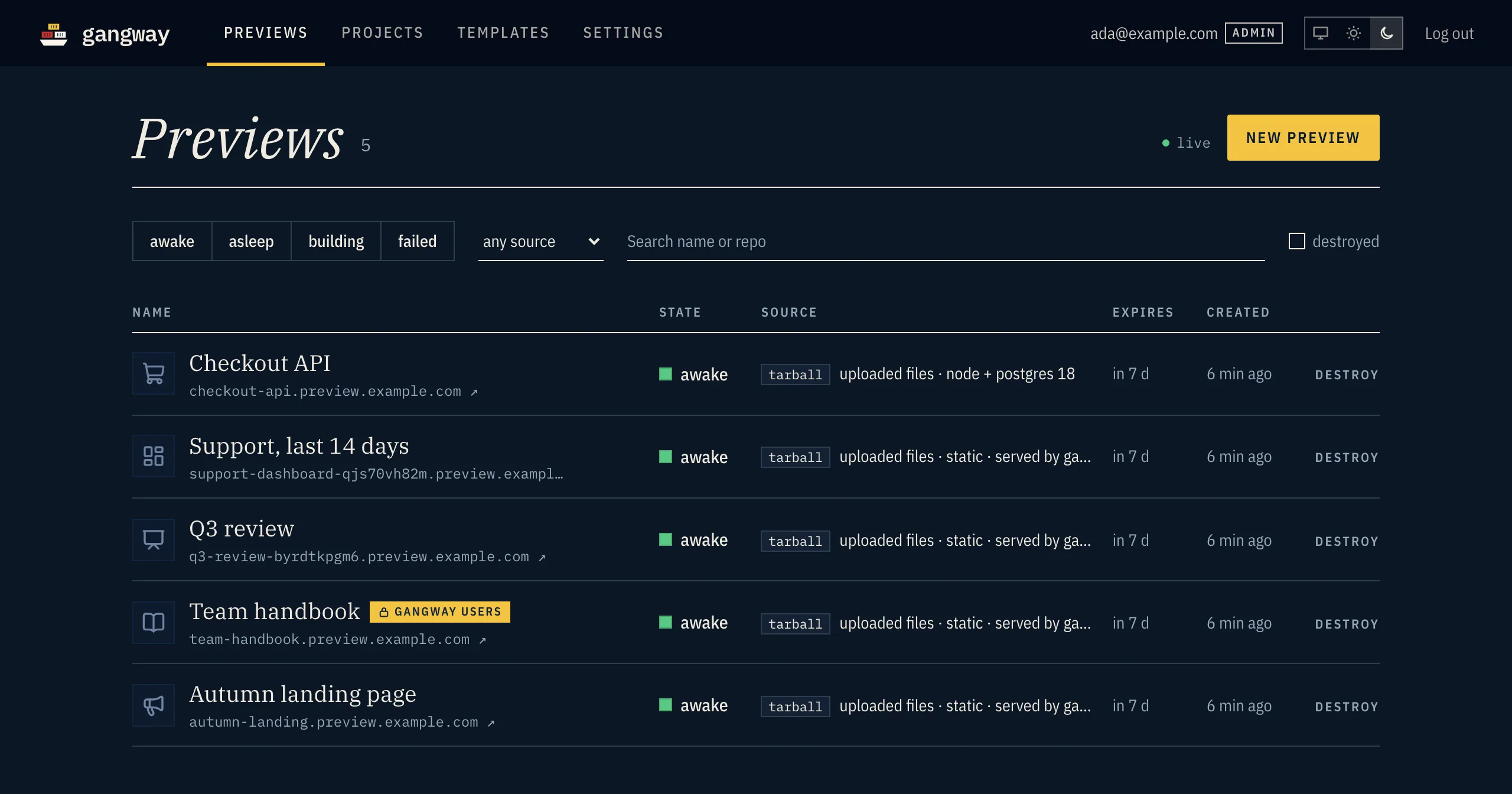
What you get
Section titled “What you get”- A URL per preview under one wildcard certificate, such as
shop-pr-142.preview.example.com. There is no certificate per preview, so Let’s Encrypt rate limits never bite. - Full Docker Compose stacks, not just single containers. Several services, healthchecks and seed hooks all work, and each exposed service gets its own hostname.
- No Dockerfile needed. Static, Node, Bun, Deno, workerd, Python and PHP apps are detected from
their files, and a
gangway.ymlcan say more. - Throwaway databases. Postgres, MySQL or Redis run beside the app, their URLs are handed to it as environment variables, and they are gone when the preview is. The preview page has a data browser.
- Previews expire and sleep. Each preview has a time to live, idle ones go to sleep, and the first request wakes them.
- You decide who sees a preview. Public, unlisted (an unguessable hostname), password-protected, or only people signed in to gangway.
- Static sites and artifacts are served by gangway itself. They need no container and deploy in
milliseconds. One
artifact.mdrenders as a document, a slide deck, a dashboard or a prototype. - Accounts and permissions. Roles are made of per-feature permissions you can remap. There are API tokens, OAuth for MCP clients, and an audit log.
How it works
Section titled “How it works”app.<domain> ─┐api.<domain> ─┼─▶ UI · REST API · OAuth ─┐mcp.<domain> ─┤ MCP │hooks.<domain> ─┘ GitHub webhooks ├─▶ builder · scheduler · SQLite │ │*.<domain> ───▶ proxy: gate, wake ─────┘ ▼ Docker API │ Docker host(s) └──────────────────▶ your preview's containersgangway routes every request by its Host header. The reserved labels (app, api, mcp,
hooks) reach gangway itself, and every other label is a preview. It runs your stack with
docker compose, under a policy that refuses anything that would reach the host: privileged
mode, bind mounts, host networking, the Docker socket and the like. It also drops Linux
capabilities and applies memory and process limits. SQLite is the source of truth, and every
container carries labels that describe it, so a restart reconciles the two.
Next: Quickstart.